
Beaverton City Directory Sources
Beaverton's historical directory shelf is small but real. The one confirmed standalone volume is a 1959 R. L. Polk book. Beaverton City Library and WCCLS accept known-item requests and offer in-library genealogy access, though their public catalog pages list no local run of directories by name or street, and no telephone books either. That gap matters. Old newspapers and state archival finding aids sit beside the Polk volume rather than replacing it, so treat them as companions to the book.
| Collection or source | Verified year or span | Where held | Access |
|---|---|---|---|
| R. L. Polk Beaverton directory | 1959 | FamilySearch Digital Library | Protected, search-only catalog access. |
| Beaverton City Library and WCCLS request route | Current service; no historic directory run verified | Beaverton City Library / WCCLS | Known-item book or microfilm request and in-library genealogy access. |
| Beaverton times | 1915 to 1922 | University of Oregon Historic Oregon Newspapers | Title-specific online issue research and noted microfilm. |
| Beaverton review | Late 1923 to 1941 | University of Oregon Historic Oregon Newspapers | Title-specific online issue research. |
| Beaverton enterprise | 1927 to 1951 | University of Oregon Historic Oregon Newspapers | Searchable weekly issues; title merged into Valley news in 1951. |
| OHRI and Washington County inventory | Series vary by record type | Oregon State Archives | Index and finding-aid route; confirm the underlying record and current custody. |
A missing year proves nothing. It only means a specific volume, publisher, and repository remain unconfirmed. No evidence supports an annual local directory sequence, a criss-cross run, or a telephone-book run for Beaverton. Keep that gap in view whenever you check a dated address or name.
The 1959 Beaverton Historical Volume
The 1959 Beaverton (Washington County, Ore.) city directory from R. L. Polk and Company is the local anchor. Its FamilySearch Digital Library catalog entry counts 526 pages. The scope reaches beyond the city itself. It covers Beaverton plus Aloha, Cedar Hills, Fairvale, Huber, Portland Heights, and West Slope. That nearby-community coverage helps when an old address sits close to a modern Beaverton boundary. It also helps for organizations near those lines. It does not fold every listed place into the city. Nor does it settle any present-day jurisdiction question. Use it as a street directory of its era, not a map of today's city limits. The FamilySearch catalog for the 1959 Polk volume carries the confirmed details. It also lists its access limits.
The catalog itself is search-only and protected. A library-assisted search turns up leads from time to time. Note the edition, year, page number, and access condition whenever one appears. A directory result is not a household census. It is not a move date or proof of land title either.
The Oregon Historical Society documents an address crosswalk for Portland directories starting in 1892. It also documents a reverse-address section from 1930 onward. Its house-history guide, however, centers on Multnomah County. Apply that material only where the address falls inside its documented reach. It offers no evidence of a Beaverton reverse directory.
Read a Beaverton Directory Carefully
Treat the 1959 Beaverton city directory as a book you must read before trusting. The volume sits behind protected access. So its exact abbreviation key, entry layout, and street section stay unknown until you open it. The same goes for relationship notations, ownership symbols, and personal-detail fields. That uncertainty matters. A careless researcher borrows a feature from another Polk title. And pastes it onto Beaverton. Never present a borrowed feature as if the 1959 book itself printed it.
| Name field | Not inspected in an accessible 1959 Beaverton entry image. |
|---|---|
| Address field | Not inspected in an accessible 1959 Beaverton entry image. |
| Relationship notation | No Beaverton example was available to confirm how, or whether, it appears. |
| Ownership notation | No Beaverton symbol or label was verified from the protected volume. |
| Abbreviation or classified section | No Beaverton key or section layout was inspected. |
- Criss-cross directory
- A directory organized by street or address rather than alphabetically. No Beaverton volume with this form was verified.
- Householder index
- An index focused on a named household contact. Its presence in the 1959 Beaverton volume was not verified.
- Abbreviation key
- A volume's guide to its shortened labels. Photograph or note the actual key when a specific book permits access.
Cite the book as a clue, not a verdict. Any claim about a Beaverton person, address, or relationship still needs a second dated record that fits the fact.
Beaverton City Directory Access at the Library
Beaverton City Library gives you a concrete known-item route rather than a vague local-history shelf. Its genealogy and microfilm request form allows five requests. Each form covers one book or microfilm item. The microfilm portion asks for title, publication place, and reel or date. The book portion wants title, author, publisher, year, and source. Contact, pickup, needed-by, and willingness-to-pay fields round out the form. That structure supports a precise request. You can name the 1959 Polk book or a chosen newspaper reel. Note: Murray Scholls is marked unavailable for microfilm, so the Main Library serves as the documented microfilm route.
The Beaverton City Library genealogy and microfilm request form displays the known-item fields. It shows the five-request limit in plain view.
Library history adds useful context for access. The first public library opened in 1925. The present library took shape with WPA help in 1938. City responsibility began in 1941. Those dates explain why a local access point arrived fairly late. They do not promise that every older Beaverton publication survives. An item may not stay in local hands or exist in digital form. For preservation context, photographs, stories, and general historic-Beaverton questions, Beaverton Historical Society is another worthwhile local contact.
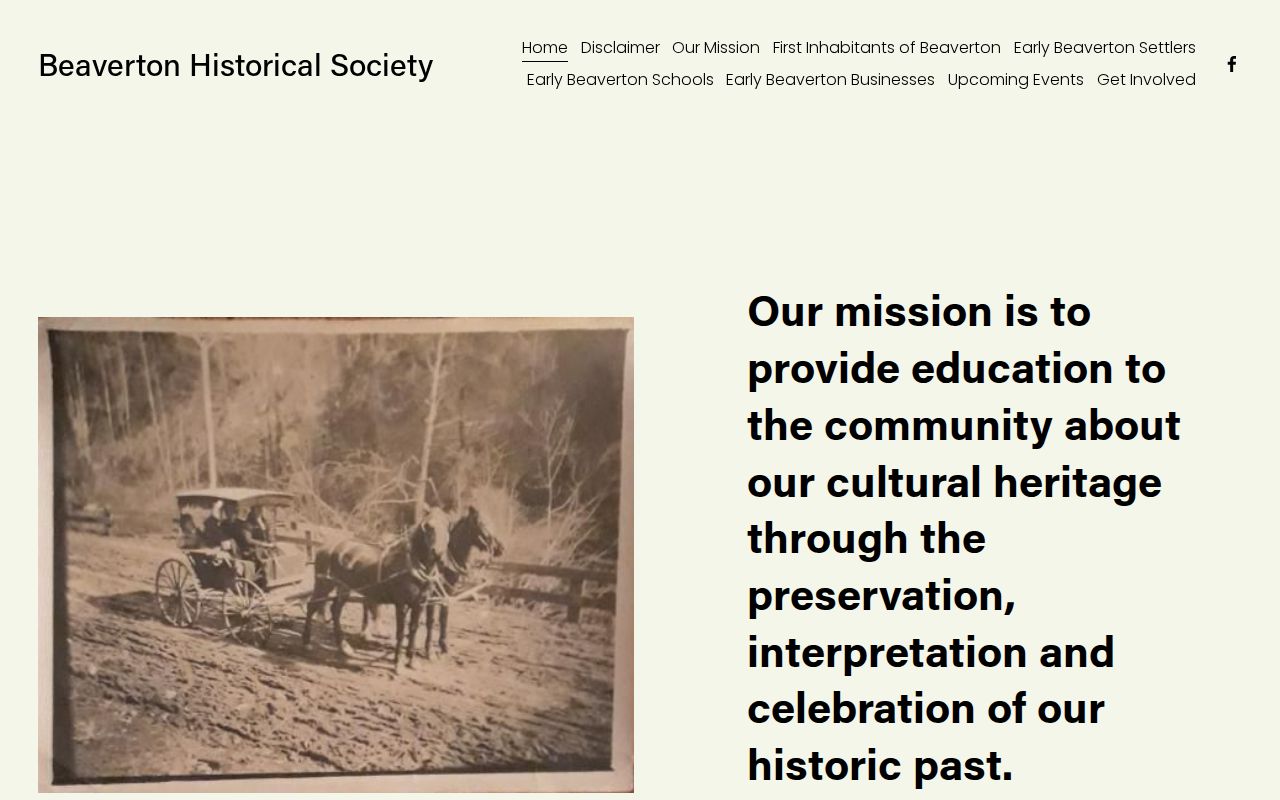
Think of the society as a historical-context resource. It is not an official government name database, nor proof that any particular collection sits online.
Beaverton Historical Newspaper Tracks
Newspaper runs pair well with a Beaverton residents directory lead. The University of Oregon's Historic Oregon Newspapers collection documents the Beaverton times from August 19, 1915 through June 9, 1922, with A. J. Hicks listed as publisher. A second title, the Beaverton review, runs from late 1923 through April 18, 1941 and names J. H. Hulett. The Beaverton enterprise spans March 17, 1927 through January 26, 1951, names S. M. Brown, and merged into Valley news in 1951. Each title covers a different stretch of Beaverton's past. Together they bracket the eras a city directory volume may miss.
Search a surname on its own. Try the street, the neighborhood, a spouse, an organization, or a place name as separate terms too. OCR is only a discovery aid, never final evidence. Open the page image itself. Record the title, issue date, page, and the spelling exactly as printed. A newspaper notice is a dated historical lead, so corroborate it before drawing conclusions about identity, residence, or property. The University of Oregon's Beaverton Enterprise title page shows the title-specific archive route into that collection.
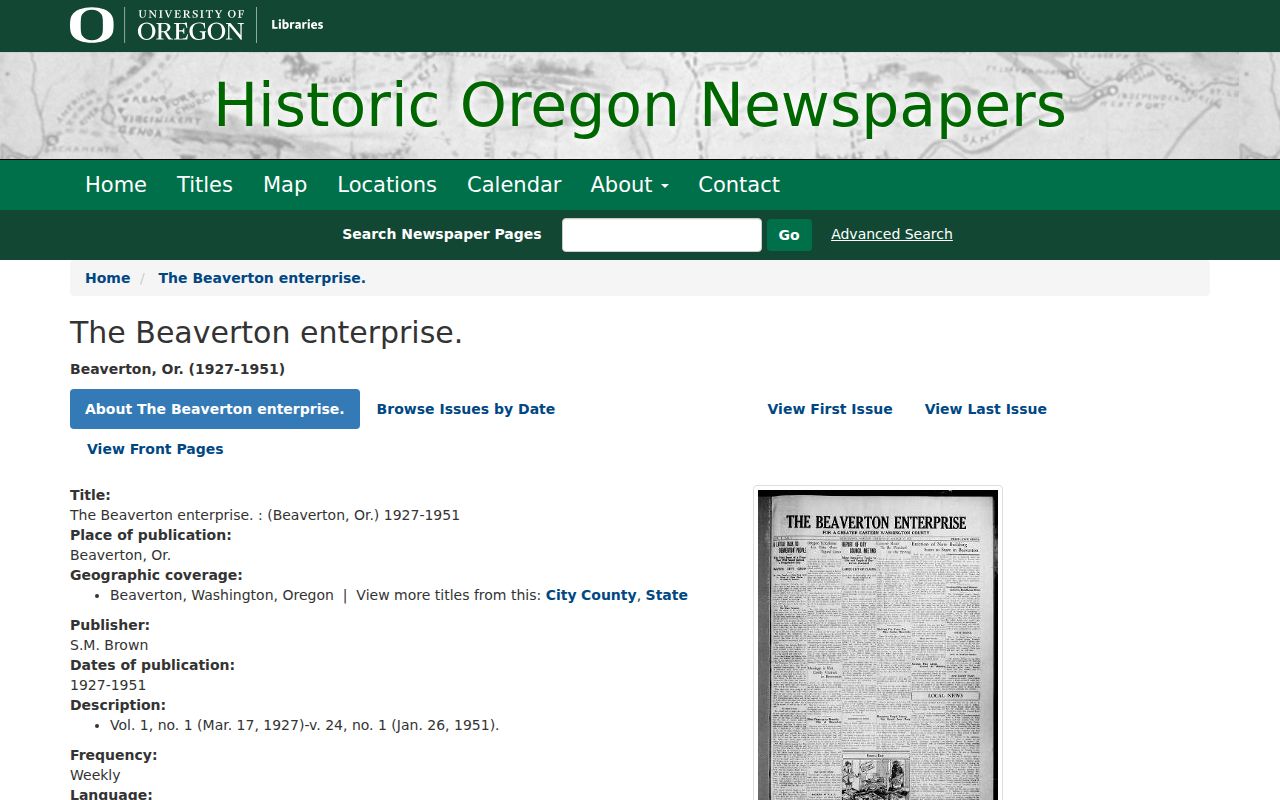
The newspaper sequence fills gaps before and after the verified 1959 book. It does not invent a continuous directory collection.
Note: A page image is the evidence, and OCR text should be checked against the visible issue before it is cited.
Beaverton Historical Record Repositories
The Oregon State Archives offers a different kind of lead. It does so through its Oregon Historical Records Index. The Washington County inventory there identifies historic naturalizations from 1844 to 1956. It also covers estates from 1842 to 1921 and guardianships from 1844 to 1921. The index also lists selected divorces and delayed births. It names Official Registers of Electors from 1902 to 1912, a 1912 Beaverton Precinct Register, and a Washington County School Census from 1905 to 1966. Treat the inventory as a record of historical existence plus its 2013 repository information. It does not promise an item remains in the same place or sits online today.
For regional history questions, the Oregon Historical Society Research Library can help. It can route questions about books, manuscripts, maps, photographs, periodicals, oral histories, and staff reference. Ask about exact holdings, access conditions, and offsite material before you travel.

This repository route complements a Beaverton residents directory entry with sources that carry their own dates, series, custodians, and access rules.
Trace Beaverton City Directory Leads
A historical search works best when each source plays one role. The directory gives a time-stamped lead. A census is a separate population snapshot. A newspaper can add a dated notice, organization, street, or family reference. OHRI or the county inventory can point to estate, guardianship, naturalization, or other archival series. If an address matters, Washington County Assessment and Recording sources can test the parcel and document side. The directory clue alone never becomes a title conclusion.
- Start with the name variants, address, place, and date range, then request or access the verified 1959 Polk volume when that year fits.
- Record the book title, publisher, edition, year, page, and access condition. Keep the exact printed form rather than silently modernizing it.
- Search the University of Oregon newspaper title that covers the target period, using street, neighborhood, organization, and family terms as well as a surname.
- Pair the dated lead with the relevant federal census or WCCLS in-library genealogy access. OHS Digital Collections identifies a Washington County census from 1856 and a tax roll from 1852.
- Use OHRI or the Washington County inventory for an estate, guardianship, naturalization, or other series clue, then confirm the original record and present custodian.
- For an address or document question, preserve the historic form and pass the tax lot, legal description, date, or instrument lead to the appropriate county office.
A disappearance from a directory proves nothing by itself. It may reflect coverage, publication, access, spelling, or indexing limits. The next dated source must do the confirming about a move, a death, or any other event.
Beaverton Library Record Timeline
Beaverton's historical path is a sequence of different custodians, not one archive. County land and court material is the early route. City-side records become relevant after incorporation. Newspapers provide a dated local run, and the library later becomes an access point. State archives and modern county systems retain their separate roles. This timeline helps a researcher pick a source by period. It does not pretend any single collection is complete.
| 1847 | First recorded land claim in the Beaverton area, directing early research toward county land, probate, tax, census, and related series. |
|---|---|
| 1893 | Beaverton incorporated, adding municipal administrative records while county offices remained legal-record custodians. |
| 1915 to 1951 | The verified local newspaper sequence covers the Times, Review, and Enterprise title runs. |
| 1925 to 1941 | Public library opening, WPA organization, and city responsibility created a later local access layer. |
| 1959 | The protected R. L. Polk volume is the verified standalone Beaverton directory anchor. |
Keep the creator and the custodian distinct. A modern library building, a digital newspaper page, or a local organization may provide access to a historical source without having created or held every original record.